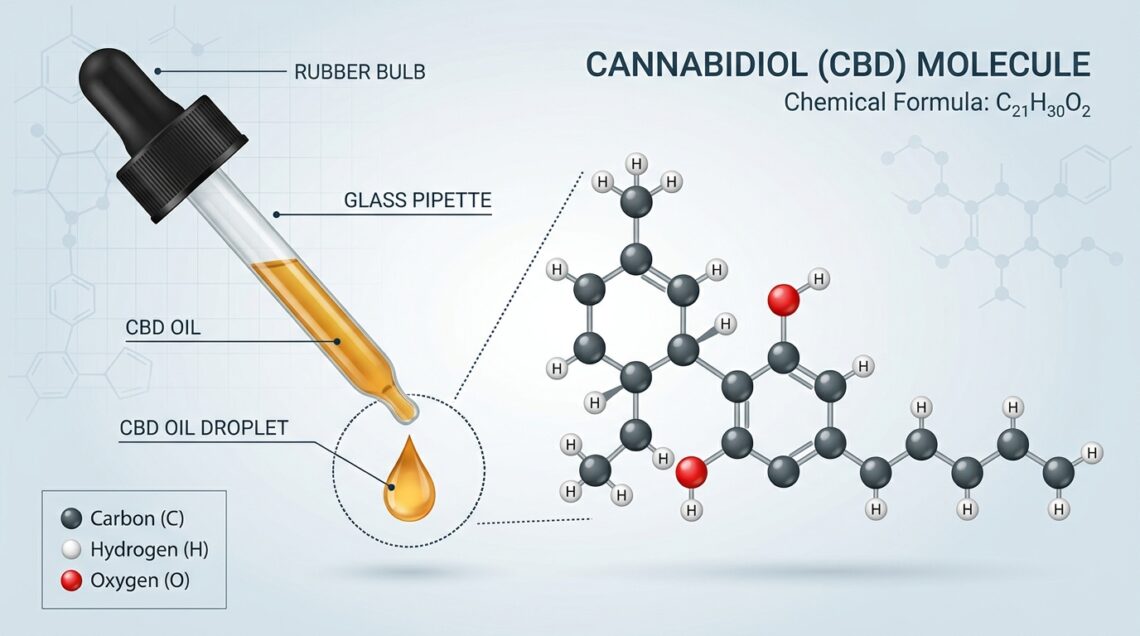
Every few months a new bottle, a new influencer, or a new testimonial repeats the same promise: one small dropper, many problems solved. Before accepting the pitch, it helps to ask what kind of evidence stands behind each promise. CBD oil has real science behind a few uses, thin science behind many, and none behind the loudest claims.
Five Claims, Checked One by One
Each claim below gets a verdict based on the kind of evidence that exists. The labels are blunt on purpose.
Claim 1: “It stops seizures”
Verdict: supported, with a narrow scope.
Purified CBD earned FDA approval as the prescription drug Epidiolex after randomized trials in Dravet syndrome, Lennox-Gastaut syndrome, and tuberous sclerosis complex. The patients were mostly children whose seizures had not responded to other medicines, and doctors dose by body weight and watch liver blood tests. That is a long way from a dropper bottle bought on impulse. The claim holds for one pharmaceutical product used for specific conditions under medical care.
Claim 2: “It calms anxiety”
Verdict: plausible, unproven at shop-shelf doses.
The published human trials measured nervousness during staged tasks such as a public speech, usually in a single session. Anxiety disorders are diagnoses with established care, including therapy and prescription medicines, and CBD has not been compared against those treatments in large head-to-head studies. A person who feels calmer after a dose may be experiencing something real. The research has not yet shown how often that happens or at what amount.
Claim 3: “It erases chronic pain”
Verdict: weak.
Two recent evidence reviews, one in the Annals of Internal Medicine in 2025 and one commissioned by the Agency for Healthcare Research and Quality, found small short-term gains, mostly for nerve pain. Most of the benefit came from products that contain THC. In a 2022 trial of CBD alone for arthritis pain, the oil and the placebo performed about the same. A sore back will not be rescued by a trend.
Claim 4: “It fixes skin”
Verdict: early.
Lab studies on oil-producing skin cells look interesting, and a few small human studies report improvement in conditions such as scars and eczema. None of it is strong enough to replace a dermatologist’s plan for acne or psoriasis.
Claim 5: “It treats serious disease”
Verdict: not supported.
In November 2019 the FDA sent warning letters to 15 companies that marketed CBD products in ways that broke federal law, including promoting them to treat diseases. The agency also said it could not conclude that CBD is generally recognized as safe in food, and it pointed to concerns about liver injury, drug interactions, drowsiness, and contaminants such as pesticides and heavy metals. Its statement challenged the idea that trying CBD “can’t hurt.” No regulator has approved CBD oil to treat cancer, Alzheimer’s disease, or most other serious conditions.
What a fair test would look like
Strong evidence has a recognizable shape. Participants are assigned to CBD or placebo at random, and neither they nor the researchers know who got which. The product is standardized, the dose is stated, and the outcome is chosen in advance, such as the number of seizures per month or a score on a validated anxiety scale. Independent teams then repeat the result. Few retail CBD uses have reached that standard, and a claim that skips it is asking for trust instead of presenting proof.
The scorecard
| Claim | Verdict | Main reason |
|---|---|---|
| Stops seizures | Supported, narrow scope | Randomized trials of one prescription drug |
| Calms anxiety | Plausible, unproven | Small staged-task studies, doses above retail servings |
| Erases chronic pain | Weak | Small gains, mostly from THC-containing products |
| Fixes skin | Early | Lab data and small human reports |
| Treats serious disease | Not supported | No approvals, FDA warning letters |
Where CBD oil may still fit
Debunking a cure-all does not mean CBD has no place. Some people use it for modest reasons, such as winding down in the evening, and report a benefit. That choice is defensible when it is made with realistic expectations, a tested product, and a clinician’s input if medicines are involved. The mistake is substituting it for treatment that has evidence, especially for conditions that worsen without care. A bottle can complement a plan. It should not replace one.
Why the Cure-All Story Keeps Spreading
The feel-better ritual
Almost any new routine can make a person feel better for a few weeks. Choosing a product, taking it at a set time, and expecting a result all shape how symptoms are perceived. Researchers call part of that response the placebo effect, and it is strong for conditions rated by feel. A good week after starting CBD oil can be a real good week without the oil causing it.
The swing back to average
Symptoms rarely sit still. Pain flares, anxiety spikes, and sleep gets worse during stressful weeks, and people tend to try something new at the worst moment. Afterward, symptoms drift back toward their usual level on their own. Statisticians call this regression to the mean, and it hands credit to whatever was started during the bad stretch.
Who writes the reviews
Satisfied customers post enthusiastic reviews. People who saw nothing happen usually stop using the product and say nothing. A page of five-star comments tells a reader about the people who chose to write, not about everyone who bought.
A compound that touches many targets
Lab work shows CBD interacting with several receptors and enzymes. A molecule with many targets invites a story that it helps with many problems. In biology, touching many targets lightly can also mean doing little at any one of them. Each condition needs its own evidence.
Cherry-picked studies
Search any database and a study turns up to support almost any claim. Selecting the positive studies and ignoring the empty ones, a habit known as cherry-picking, makes a weak field look strong. The Danish arthritis trial that found no benefit over placebo rarely appears on a product page. Systematic reviews, which gather every trial instead of the flattering few, are the antidote.
The economics of enthusiasm
Enthusiasm pays. Brands, affiliate sites, and influencers earn money when a reader decides to buy, and confident headlines draw more clicks than careful ones. Products sold outside the drug approval system do not have to show benefit before they reach a shelf. Nobody needs to be dishonest for the incentives to tilt the conversation toward optimism.
A regulatory gap
Most CBD oils reach shoppers without the kind of premarket review that applies to medicines. The FDA said in 2019 that many people wrongly assume the products on the market have been evaluated and found safe. That gap leaves hype with plenty of room.
A Pocket Test for Any CBD Claim
Five questions
- Who was studied: people, animals, or cells in a dish?
- Was there a placebo group, and were people assigned to groups at random?
- How large was the study, and how long did it last?
- What dose was used, and does a bottle deliver that amount?
- Does the claim name a specific condition and a measured outcome?
A claim that fails most of these questions deserves caution. One that passes them all is rare and usually modest.
Hype and honest wording side by side
| Hype | Honest version |
|---|---|
| CBD oil cures anxiety | In a small trial, one large dose lowered nervousness during a staged speech |
| Proven to relieve pain | Reviews report small short-term gains, mostly from THC-containing products |
| No side effects | Trials report diarrhea and drowsiness, and some people show raised liver enzymes |
| Works for everyone | Response varies, and placebo groups improve too |
Reading one headline
Imagine a headline that says “Study shows CBD oil cuts anxiety by 60 percent.” The pocket test takes a minute. Who was studied: ten healthy volunteers or two hundred patients? What was the dose, and was it larger than any bottle serving? Compared with what: a placebo, or nothing at all? Over what period: one afternoon or three months? Cut anxiety how: a self-rated scale or a clinical interview? The numbers sound strong, and the missing answers decide whether they mean anything. The headline is hypothetical, and real ones often leave out the same details.
Words that should slow things down
- “Miracle,” “cure,” or “breakthrough”
- “Clinically proven” with no study named
- “No side effects”
- Testimonials standing in for data
- A single study cited as if it settled the question
- Urgent discounts attached to health claims
Careful writing sounds different. It says “may,” names the number of participants, and states the comparison group. Plain, modest language is a good sign.
When a friend swears by it
A friend’s success story deserves a kind hearing and a few questions. Which product, at what dose, for how long? Did anything else change during that time, such as sleep, medication, stress, or exercise? Were there side effects? A story with answers is useful information, and a story without them is an anecdote. Anyone considering the same product can take the story to a pharmacist or doctor instead of treating it as a prescription.
Final Thoughts
CBD oil is not a cure-all. It has real evidence for a few specific childhood epilepsies and thin or mixed evidence for most other uses, and none for curing serious disease. The stories that make it sound universal come from placebo effects, normal ups and downs, and selective reviews. A calm look at who was studied, what dose was used, and how big the result was keeps expectations realistic.